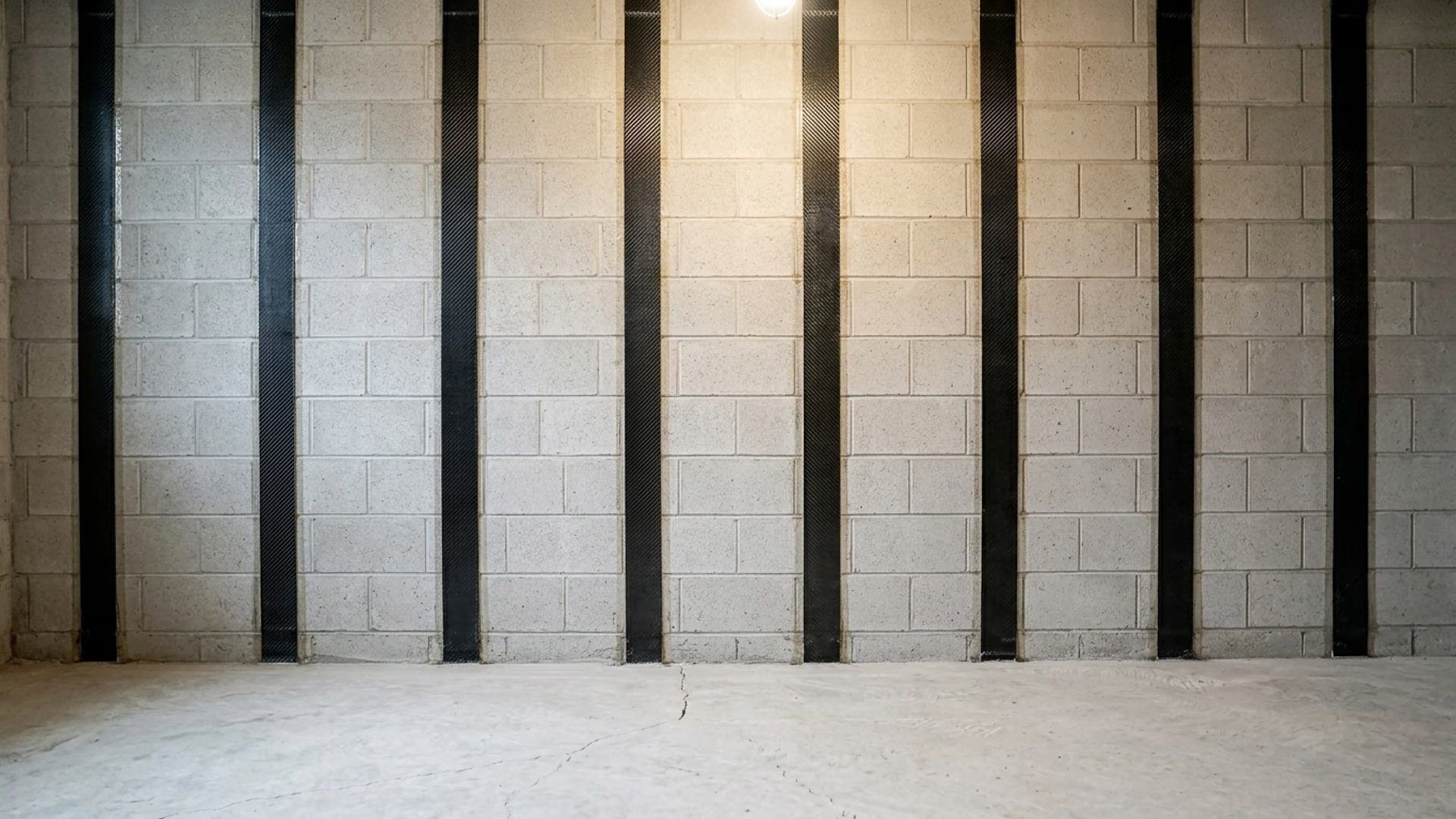
You've probably already done the test: stood at the corner of the basement and sighted down the wall, and there it is — an inward curve that shouldn't be there, deepest around the long crack running across the wall at about waist height. Maybe you've compared it against last fall and decided the bulging basement wall is a little worse. That's the point where bowing basement wall repair in Wichita, KS stops being something to read about and becomes something to price — and the first honest thing to know is that a bowing wall is a measurement problem before it's a repair problem. Inches of deflection decide the fix, most walls are stabilized in place rather than rebuilt, and the measurement itself costs nothing. We handle exactly this work — straps, anchors, tiebacks, and braces — for homes and commercial buildings across Wichita and about 30 miles around it. Get a Free Estimate and the wall gets measured before anyone talks price.
Why Wichita Basement Walls Bow Inward
A basement wall bowing inward is losing a slow contest with the soil on the other side of it. Sedgwick County sits on expansive clay, and that clay runs a yearly cycle: summer drought shrinks it until it pulls back from the foundation, then the fall rain systems — and the wet springs — soak it back to full volume. Saturated clay is heavy and it pushes sideways, hard; local contractors cite lateral pressures in the thousands of pounds per square foot against a buried wall.
A block (CMU) wall gives first at mid-height, because that's where the bending stress peaks between the braced top and the footed bottom. The mortar joint opens, and you get the long horizontal crack homeowners find first. Poured concrete walls resist longer, but they lean too. Every wet season is another load cycle, and each cycle can push the wall another fraction of an inch out of plumb — which is why the bulge reads deeper than it did last year, and why it will not read shallower next year on its own.
How Much Bowing Is Acceptable? Reading the Wall
No ranking page in this market will give you a ruler, so here is the general industry guidance, plainly stated. Under about one inch of deflection, with no evidence the wall is still moving, the right answer can be to measure and monitor — repair is not automatic. Around one inch, with movement confirmed between dated readings, stabilization is warranted. At roughly two inches, or when the wall is shearing or sliding at its base, you're in serious structural territory that needs bracing-grade work, not a couple of straps.
The tell-tales are readable without a contractor: the mid-height crack, stair-step cracking at the corners where the wall panels rack, and an inward lean you can quantify with a four-foot level or a plumb line from the top block. Our guide to foundation warning signs walks through the full symptom list. One useful distinction while you're down there: a crack that isn't paired with deflection is often a sealing job rather than a structural one — that's foundation crack repair territory. The principle behind all of it: bowing is measurable, not guessable. A company should show you deflection numbers before it shows you a contract, and a measurement costs nothing.
Carbon Fiber Straps: Stabilizing Minor Bowing
For walls under about an inch of deflection, carbon fiber is usually the cleanest fix. Installing carbon fiber straps on a basement wall means epoxy-bonding high-strength fiber straps vertically to the wall face and anchoring them top and bottom, so the wall and strap act as one much stiffer member that the clay can no longer bend. The appeal is practical: no yard excavation, a profile flat enough to paint or finish drywall over, and installation commonly done in a day.
Now the limit no sales-driven page will state outright: straps stop movement — they do not pull a wall back straight. A strap system on a wall that has already moved past strap territory is money spent on the wrong hardware. That's not a reason to fear straps; it's the reason the deflection number has to come first.
Wall Anchors, Helical Tiebacks, and Steel Braces
Past an inch, the method ladder climbs. Wall anchors are the workhorse for Wichita walls in that band: earth anchors set in the yard beyond the wall, connected through it by threaded steel rods to interior plates. The assembly clamps the wall against the clay's push — and because it's tightening hardware, anchors snugged gradually across dry seasons, when the shrinking clay relaxes its grip, can recover some of the wall's straightness. The requirement is yard access several feet beyond the foundation.
When there is no yard to use — lot lines, a driveway, buried utilities — helical tiebacks do the same job from the other direction: screw-in anchors driven at an angle from inside the basement into load-bearing soil. And for severe deflection, or a wall shearing at its base where clamping is no longer the right physics, vertical steel I-beam braces are footed at the slab and tied to the floor joists so the house's own structure carries the wall.
The selection logic is the honest part: the wall's measurements and the lot pick the method — not the installer's product line. Our written estimate states which method and why.
What Bowing Wall Repair Costs in Wichita
Market context, with the caveat kept visible: carbon fiber straps commonly run about $350 to $800 per strap and wall anchors about $400 to $900 per anchor — industry-typical figures rather than locally verified ones — and most full-wall stabilizations land between $4,000 and $15,000 per wall. What moves the number: inches of deflection (which sets the method), wall length (which sets the unit count, since straps and anchors go in on regular spacing), interior versus exterior access, and whether a finished basement has to be opened up and restored. Those are market figures, not quotes. Our only price statement is the free written estimate, with the measurement and unit count that produced it.
A Moving Wall, a Wet Wall, and the Wichita Calendar
The same saturated clay that bends a wall inward will also push water through it, and if your bowing wall is a leaking wall too, drainage relief belongs in the permanent plan — that side of the problem is covered on our basement waterproofing page. Likewise, if the bow comes with settlement symptoms — doors that won't latch upstairs, floors sloping toward one corner — start at the foundation repair hub, because the wall may not be the only thing moving.
On timing, the physics sets the schedule better than any sales pitch could: stabilization holds best when it goes in before the next wet season loads the wall, and in Wichita that means planning ahead of the October rains that follow the summer shrink. Wichita Foundation Repair Co handles bowing wall work across Wichita, Sedgwick County, and roughly 30 miles out — including Andover, Derby, Newton, and the surrounding towns — for residential and commercial buildings alike. Get a Free Estimate or call (316) 330-0156, Monday through Saturday, 8:00 AM to 6:00 PM. The wall gets measured, the numbers go in writing, and the method follows the measurement.