You know the routine by now. A storm line crosses Sedgwick County overnight, and by morning water is tracing the wall-floor joint in the same corner of the basement. Or the finished room downstairs has that damp-cardboard smell again. Or white chalk keeps climbing the block no matter how many times it gets scrubbed off. Basement waterproofing in Wichita, KS exists for exactly that pattern — and the honest version of it starts with something most companies bury: some wet basements need a full drainage system, and a surprising number need gutters, grading, and a weekend. We handle both answers, for homes and commercial buildings across Wichita and about 30 miles around it, and the evaluation that tells you which one you have is free. Get a Free Estimate and find out before anyone talks systems.
Before You Price a System, Check What's Feeding the Soil
The least expensive waterproofing work never touches the basement. Clean gutters, downspout extensions that discharge 6 to 10 feet from the wall, and grading that slopes away from the foundation all do the same thing: they stop pouring roof water into the backfill sitting against your basement wall. A single downspout can move hundreds of gallons in one storm, and if it dumps at the corner of the house, that corner is where the floor gets wet.
Wichita's summers make this worse in a specific way. Drought shrinks the clay and opens gaps along foundation walls — so the first big fall rains don't soak in across the yard, they funnel straight down the gap and land at the footing. Extensions and regraded backfill close that path for a fraction of any system's cost. If surface water turns out to be your whole problem, we tell you so, and that advice costs nothing. A drainage system is for water the soil delivers no matter what the roofline does.
Why Wichita Basements Take On Water
Sedgwick County sits largely on Tabler-series silty clay loams — USDA hydrologic group D, the slowest-draining, highest shrink-swell classification there is. Rain that lands here cannot percolate away at any useful speed. It saturates the soil beside the wall instead, and saturated clay generates hydrostatic pressure: water gets pushed through the wall-floor joint, through cold joints, and through any crack that offers a path. That is why the classic complaint is water in basement after rain and a bone-dry floor the rest of the month — the pressure comes and goes with the weather.
River-adjacent neighborhoods add a second mechanism. Around Riverside, Delano, and Midtown, near the Arkansas and Little Arkansas confluence, a genuinely shallow water table keeps sump pumps cycling through wet springs even when surface drainage is perfect. And the white chalky residue on basement walls — efflorescence — is dissolved minerals left behind where water migrated through the concrete and evaporated. It is not mold and not paint failure; it is proof of moisture in transit through the wall. October is the proof season for all of it: fall rain systems landing on drought-shrunk clay is when Wichita basements fail.
Interior Drain Tile and Sump Systems — Managing the Water
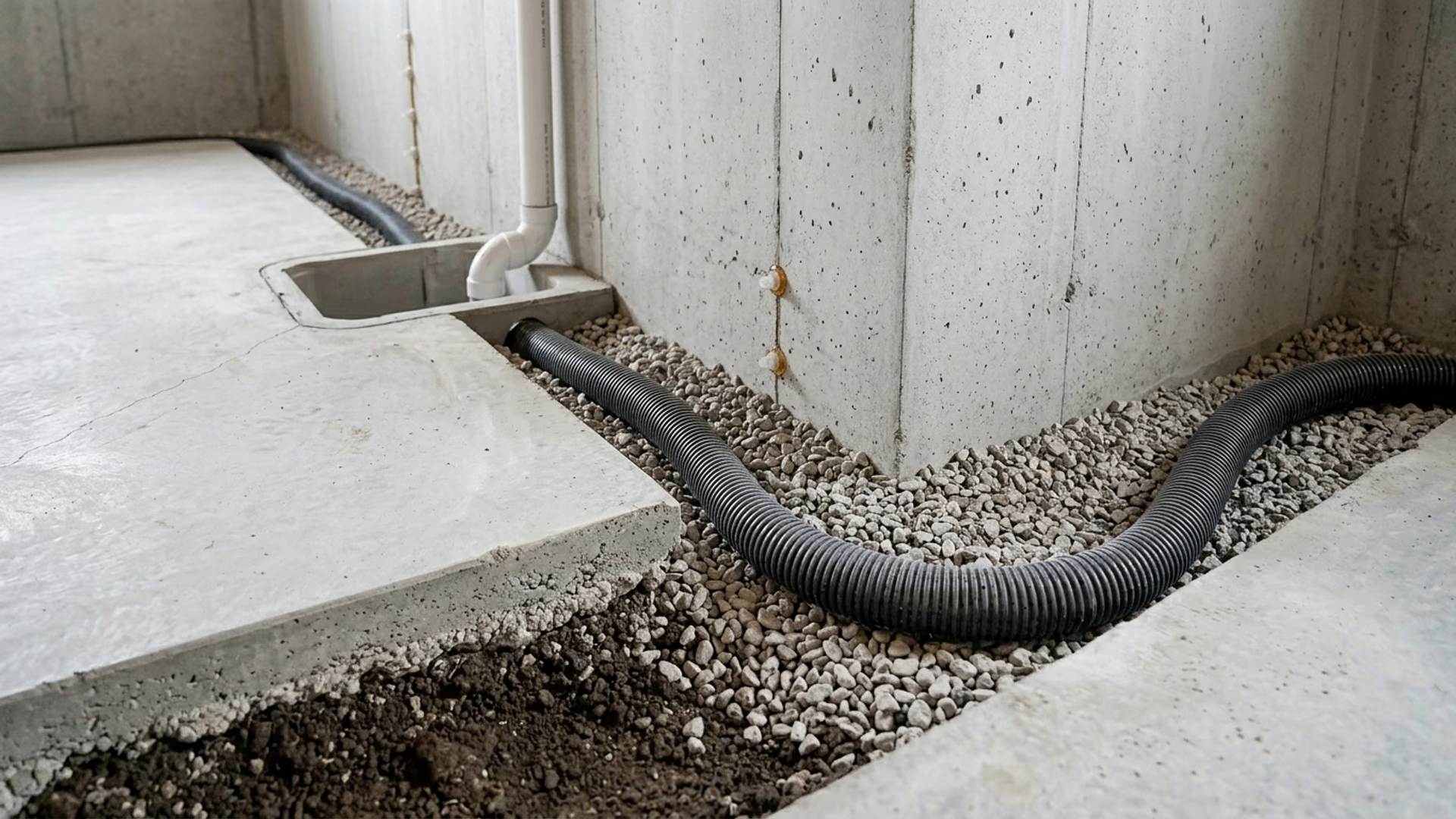
For most wet basements here, interior drain tile in Wichita homes is the working answer, whatever brand name a competitor's brochure hangs on it. The machine is simple. A channel is cut at the edge of the slab around the affected perimeter. Perforated pipe — drain tile — goes into that channel, bedded in washed gravel below slab level, where it collects both the water weeping down the wall and the water rising under the slab. The pipe drains to a sump basin, and the pump sends it out a discharge line routed well away from the house.
Understand what the system does and doesn't do: it does not stop water from reaching the wall. It intercepts that water below the floor before it can surface, which relieves hydrostatic pressure at the footing — managing the water instead of fighting it. On weeping block walls, a wall vapor barrier ties into the channel so water inside the block cores is guided down into the drain instead of onto the floor. A battery backup pump belongs in the conversation for one plain reason: the storm that floods a basement is often the same storm that cuts the power. And on flat lots, discharge routing deserves real design attention, or the pump just lends the same water back to the soil.
Sump pump installation in Wichita is also a standalone job. Plenty of homes have a system that only needs a tired pump replaced, a basin added at a low corner, or a backup unit installed ahead of the wet seasons.
Exterior Waterproofing — Blocking Water at the Wall
The other approach excavates to the footing, applies a waterproof membrane to the outside of the wall, and lays new exterior drain tile — blocking water instead of managing it. It is the most thorough fix available, and it costs multiples of an interior system while tearing up landscaping, walks, and anything else along the wall. The honest selection logic: exterior work earns its premium for chronic wall-face seepage, for walls already being excavated for structural repairs, or when new interior finishes justify keeping the wall itself dry. For most Wichita retrofits, interior systems win on cost, disruption, and practicality. We don't run a dogma either way — the written estimate says which fits your basement, and why.
What Basement Waterproofing Costs in Wichita
Market-wide, full interior systems typically run $3,000 to $10,000. An interior French drain and sump for a typical basement — call it 130 lineal feet — commonly lands between $4,500 and $7,500. A sump pump installed runs $800 to $3,000, with battery backup adding several hundred, and exterior excavation waterproofing costs multiples of comparable interior work. What moves the number: lineal footage, slab thickness and access, discharge routing, the water table, and whether the basement is finished. Those are market figures, not quotes — our only price statement is a free written estimate. The full breakdown lives in our basement waterproofing cost guide.
Wet Walls, Moving Walls, and Beating the Fall Rains
One boundary matters here: if a wet basement wall is also bowing inward or carrying a horizontal crack, water is no longer the whole problem — the saturated clay is pushing the wall itself, and that is structural work handled under bowing basement wall repair. Likewise, moisture alongside settlement symptoms — sloping floors, sticking doors — belongs with our foundation repair evaluation.
For everything that is purely water, the calendar favors acting before the fall rains: October is when drought-shrunk clay meets its first big storms, and a system installed ahead of that window is a system tested by it. Wichita Foundation Repair Co handles basement waterproofing across Wichita, Sedgwick County, and roughly 30 miles out — including Derby, where east-side clay and west-side river alluvium produce both kinds of wet basement, and El Dorado to the northeast. Call (316) 330-0156, Monday through Saturday, 8:00 AM to 6:00 PM, or Get a Free Estimate — and if the fix is a pair of downspout extensions, that is exactly what the estimate will say.