The crack started at the corner of a window and worked its way up the brick in stair steps. The back door sticks all August and swings free again by Thanksgiving. There's a hairline crack in the drywall above the hallway door, and the living room floor reads just slightly downhill toward one corner. If that sounds like your house, this page is for you. It explains how foundation repair in Wichita, Kansas actually works — how settlement gets diagnosed, what pier systems do, and what the numbers typically look like — because the difference between a modest monitoring plan and a $20,000 pier contract should be a measurement someone shows you, not a story someone tells you. Wichita Foundation Repair Co handles residential and commercial foundation work across Wichita, Sedgwick County, and roughly 30 miles in every direction, Monday through Saturday, 8:00 AM to 6:00 PM, with a free estimate on every evaluation.
What foundation settlement looks like in a Wichita house
Differential settlement is a plain idea with expensive consequences: one section of your footing loses soil support and drops relative to the rest of the house. In Wichita, the usual reason is the clay itself. Much of the metro sits on Tabler silty clay loam — USDA hydrologic group D, the highest shrink-swell classification — an expansive clay that shrinks hard away from footings in a drought summer and swells back with every wet spring and fall. The footing follows the soil, and the house follows the footing.
The symptoms tend to arrive in a ladder. Doors sticking and drywall cracks above doors and windows usually come first, because wall openings are the weakest points in the frame. Then doors and windows go visibly out of square and stop latching. Then stair-step cracks in brick or block appear, following the mortar joints up the wall. At the top of the ladder: sloping floors, gaps opening under baseboards, and a shadow line where the wall is pulling away from the ceiling. The bottom rungs usually mean monitor. The top rungs — or any crack that's clearly wider than it was last year — mean measure now.
That distinction, active versus dormant movement, is the entire diagnosis. Seasonal hairline movement that opens in August and closes in November is a different animal from a crack widening year over year — and you cannot tell which one you have by looking at it. For the cracks themselves — injection, sealing, and gauge-based crack repair and monitoring — there's a dedicated page; this one covers what to do when the structure is actually moving.
The elevation survey: measurements before recommendations
An elevation survey is floor-level mapping. Using an instrument in the zip-level class, readings are taken across the slab or basement floor on a grid and recorded in fractions of an inch. The result is a map of the structure's highs and lows: where it has moved, how much, and in what pattern.
That map is what turns "your foundation is failing" into "the southwest corner is 1-3/4 inches low, and here is the plan for exactly that." Settlement leaves a signature — a corner drop reads differently than a sagging mid-span, which reads differently than heave — and pier count and placement come from the survey. Anyone quoting piers without one is guessing, or selling.
What you keep is the paperwork: the readings, written into a scope that separates fix-now from monitor. If the survey says the movement is minor or seasonal, the recommendation is monitoring — re-measure on a schedule, and spend nothing on steel until the numbers say otherwise. If it says active settlement, the scope states which system, how many piers, and where. The estimate is free either way, and it's written so you can compare it line by line against anyone else's bid.
Steel push piers vs. helical piers
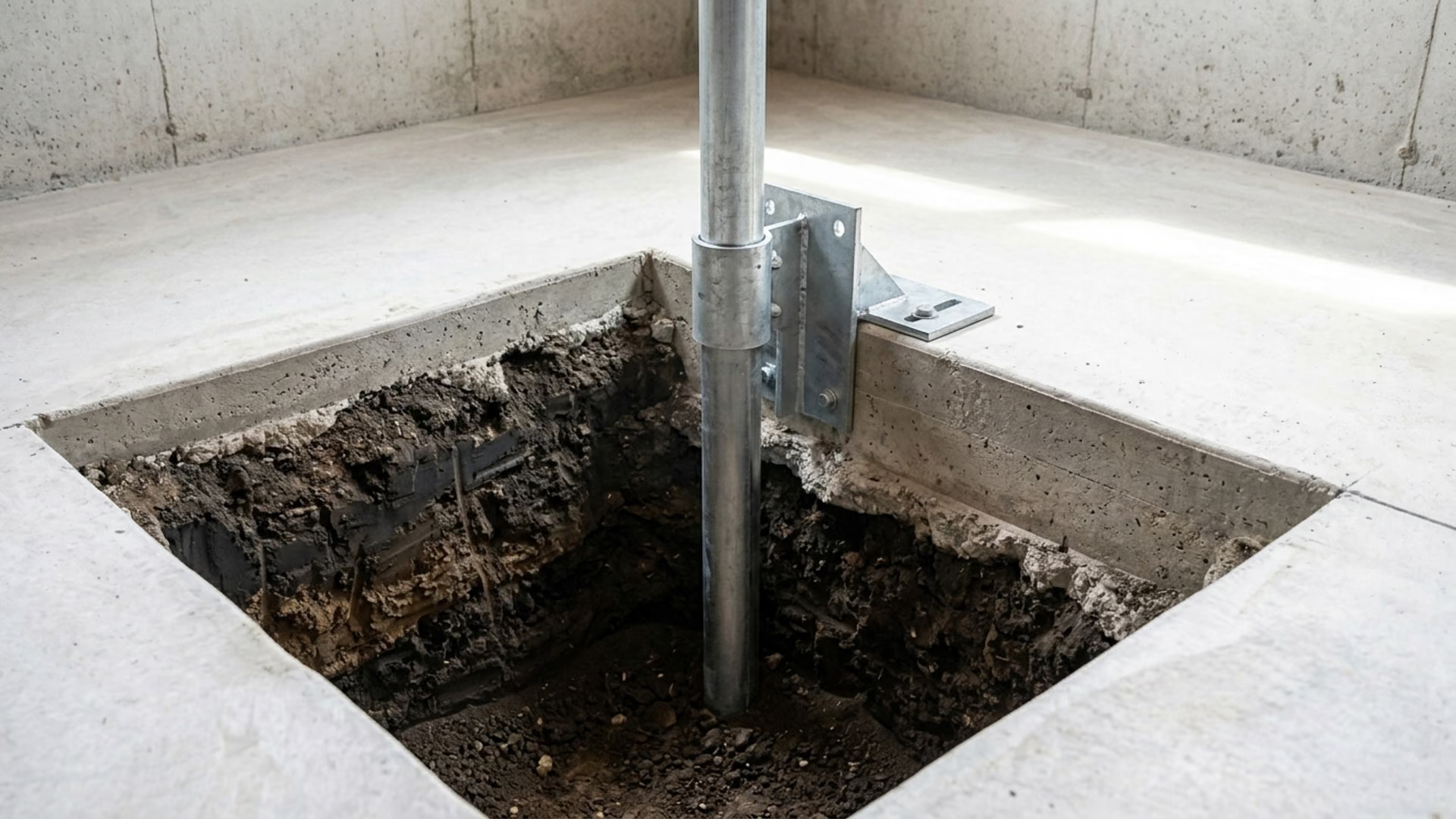
Underpinning — transferring the house's weight off failed soil and onto deeper, stable material — is the umbrella that foundation settlement repair in Wichita falls under, and it comes down to two steel systems that reach stable ground in different ways.
Steel push piers are hydraulically driven straight down through a bracket mounted at the footing, using the structure's own weight as the reaction force. Sections of steel tube are pressed until drive pressure confirms refusal at load-bearing strata — often well below the zone where Wichita's clay swells and shrinks. Because the drive force pushes against the building, push piers favor heavier structures: full-mass brick two-stories, large additions, anything with real load over the footing. Depth capacity through deep clay is excellent, and every pier's capacity is effectively load-tested during installation.
Helical piers are screwed into the soil like a giant earth anchor, helix plates carrying the load, and installed to a specified torque spec — capacity verified by torque correlation rather than drive pressure. That makes them the right call for lighter structures that can't provide push-pier reaction force: porches, stoops, single-story frame homes, and new construction, or sites where push piers can't practically reach refusal.
Neither is "the best pier." A bidder pushing one system for every house is selling inventory, not engineering. Steel push pier installation in Wichita is the right answer when the elevation survey and the structure's weight say it is — and the wrong one when they don't. The survey decides; the scope explains why.
One boundary worth naming: piers fix vertical settlement. A basement wall bowing inward is a different problem entirely — lateral clay pressure against the wall, different physics, different fix — and belongs on the bowing basement wall repair page.
What foundation repair costs in Wichita
Every figure below is market data — what projects typically run in and around Wichita — not a quote. Your number comes from a survey, in writing.
| Repair | Typical market range | What moves the number | |---|---|---| | Crack injection (epoxy or polyurethane) | $250–$800 minor; $500–$2,500 structural | Width, length, active vs. dormant | | Steel push pier | $1,200–$3,000 per pier | Depth to load-bearing strata, access, load | | Helical pier | $1,500–$2,500 per pier | Torque spec, soil, structure weight | | Typical pier project (6–10 piers) | $9,000–$25,000 | Pier count — which the survey determines | | Full perimeter piering | $10,000–$30,000+ | Home size and complexity | | National average project | ~$5,100 (typical $2,200–$8,100) | The sanity-check anchor |
Three drivers move nearly every settlement quote: pier count, depth to load-bearing strata, and access (a pier under an open exterior footing installs very differently than one under a porch slab). Pier count dominates — which is exactly why it should come off elevation readings rather than a salesperson's instinct.
Keep the national line in your pocket: the average repair project runs about $5,100, and most fall between $2,200 and $8,100. Plenty of Wichita houses genuinely need $15,000 of steel — but if the first bid you see is five figures and nobody showed you a floor-level map, that anchor stat is your cue to slow down. For the full Wichita cost breakdown — crack injection, waterproofing, leveling, and what makes each range move — see the cost guide.
An honest assessment, in writing
Foundation repair is a five-figure decision that gets sold, too often, by commissioned inspectors — and in Wichita, the national consolidators run exactly that model at scale. The counterweight isn't a better sales pitch; it's paperwork. Every evaluation here produces four things: a measured elevation survey, so the conversation starts from numbers instead of adjectives; a written scope that separates fix-now from monitor, because many cracks need neither piers nor panic; a repair plan documented clearly enough for an independent structural engineer to review; and a free estimate you can set next to any other bid without translation. If a proposal is only as strong as the fear in the room, it doesn't survive that comparison — and if you're already holding a quote you're unsure about, you can get a second opinion on an existing quote before committing to anything.
Serving Wichita and the surrounding clay belt
Wichita Foundation Repair Co is based in Wichita and works across Sedgwick County and roughly 30 miles out — Derby, Haysville, Andover, Maize, Park City, Newton, and El Dorado included. The same Tabler-class shrink-swell clays run under most of that radius, so the pattern is the same from a Riverside bungalow to a Derby two-story: clay moves, footings follow, and the fix starts with a measurement. For neighborhood-level detail, see foundation repair in Wichita.
If someone has told you your house needs piers, get it measured before you sign. Get a Free Estimate or call (316) 330-0156 — Monday through Saturday, 8:00 AM to 6:00 PM.